The Hundred (100s) is one of the most widely recognized exercises of the Pilates matwork and also one of the more choreographically complex. It is the first exercise in the matwork series in Joseph Pilates book Return to Life Through Contrology, and its expansive breathing and percussive pumping arms increases oxygen exchange circulating blood and energizing the body for the exercises to follow. The name comes from the hundred pumps achieved through 10 sets of 5 arm pumps during inhalation and 5 arm pumps on exhalation. Breaking down the components of the 100s into individual sections can help students more easily grasp each element as it integrates into the exercise as a whole. This awareness improves mental concentration yielding more fluid and precise movements.
The key elements found in the 100s include quality of breath and its influence on core connection; sequence of abdominal muscle recruitment; and scapular stabilization to power the arms. I have had a few clients who initially expressed a dislike for this exercise, and later changed their minds after integrating the various parts into a more coordinated whole.
BREATHING
The fundamental element in the 100s is breath, and costal (chest) breathing is necessary to perform the 100s effectively. During a normal breath the diaphragm contracts and descends to make more space available in the chest cavity for the lungs to fill and the belly expands. Although this diaphragmatic breath pattern is oxygen-rich, it is ineffective for the 100s since it does not provide adequate support for the lumbar spine when the legs are in the air. The abdominal muscles must be engaged during the inhalation phase of the breath cycle to counterbalance the weight of the legs. This abdominal cinching action reduces available expansion during inhalation to the chest cavity alone. If your client has only experienced diaphragmatic breathing, it may be difficult to maintain the engagement of the transversus abdominis on the inhalation and she may also feel that she does not get enough air with costal breathing alone. Therefore, proper activation of respiratory muscles must first be explored. Select the exercises most accessible and applicable to your client’s needs.
Exercise 1—Lying in Clay
Have your client lie supine and direct her to imagine she is lying in clay or sand. On the inhalation have her visualize that she squishes the ribcage down and wide making a perfect imprint. The breath should also open the sides of the ribcage so the thought of breathing through gills like a fish can also be useful. Breathe in through the nose for 4 counts and out through the mouth for 8 counts.
Exercise 2—Inner Tube
Note that some people use their facilitating respiratory muscles to do the job of the primary respiratory muscles causing the shoulders to lift and lower during each breath. To prevent this, have her imagine that an inner tube is around the chest and to breathe 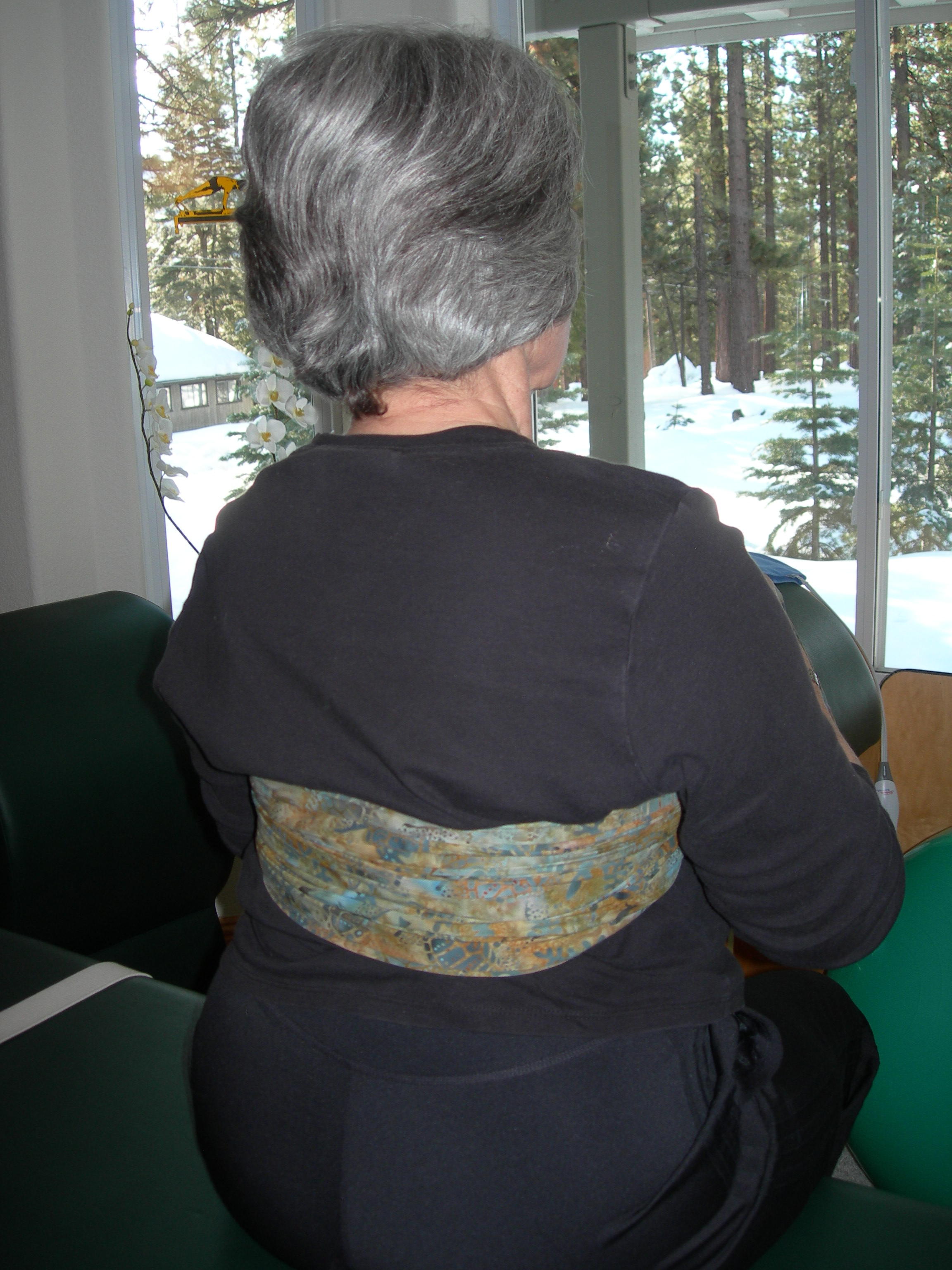 only in this area. You can wrap a scarf around the ribcage for better feedback. Direct her to pull air through her nose and take as many “sniffing” breaths as possible filling up this inner tube and notice the feeling of the muscles engaging in the chest. The last few sniffs will not yield more air intake, but will feel more like intercostal muscles around the ribcage firing. After performing this sniffing breath a few times, go back to normal breathing and she should feel that it is easier to expand the chest and fill up the inner tube.
Have your client imagine that she is breathing only through the right lung. Direct her to feel the breath in the back, front and side of the ribcage. Be sure she feels the expansion of the right ribcage through her focused attention. Then direct her attention to the left side. After feeling each side individually, have her feel the volume available when she breathes into both sides. This exercise demonstrates to your client that she controls muscle activation by thought and that greater attention can lead to an increased reaction.
Exercise 4—Physioball
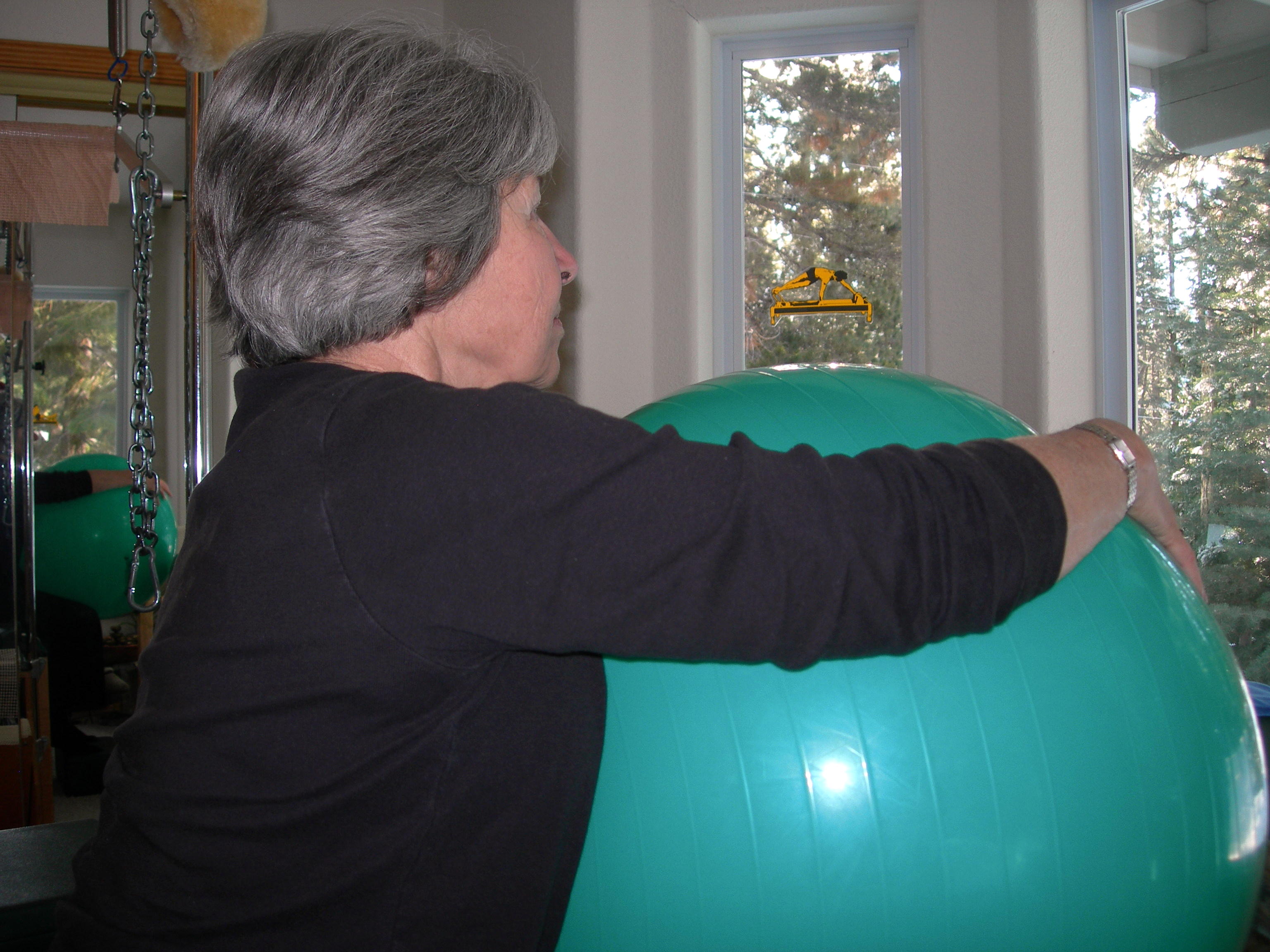
If your client lack s the proprioceptive awareness of chest expa
 nsion, it is helpful to sit next to a physioball and lean into it. The physioball gives better feedback as it “dents in” on the inhalation and “pops back” into the ribs on the exhalation. Assist your client to experience breath in the sideways, dorsal and ventral positions by holding the ball pressed toward her body as she breathes. Use a smaller ball than the one pictured if your client has shoulder issues and cannot raise the arm comfortably.
Although a full breath in the chest includes breathing into the front of the chest, this can hinder lumbar support when lying supine and holding the legs in the air. When people breathe anteriorly, they often lift the chest off the floor diminishing the supported counter-leverage necessary to hold the legs in the air. Have your client visualize squeezing a marble below the xiphoid process and hold it on the exhalation with the narrowing of the ribs. Suggest that your client take an inhalation without losing the marble. This requires the breath go to the back and to the side of the ribs in a saddle shape. The marble image keeps the thoracic vertebrae pressed into the floor maintaining the strength of the posterior pelvic tilt and support for the lumbar region.
Exercise 6—Elevator
The activation of the transversus abdominis or concept of “navel to spine” requires a cumulative response that evolves and deepens on each exhale. Clients will often tighten the abs in a bracing action as if waiting for a punch to the gut. This is a static engagement and works from the outside in. The transversus abdominis should initiate from the inside, as if the organs are inviting the abdominal wall inward. Guide your client to imagine the abdomen as an elevator. Keep the abdominals engaged holding the elevator level to let the people in on the inhalation (using a costal breath). As she exhales lower the elevator from the 3rd floor to the 2nd floor and feel the navel drop toward the spine in a relaxed action as if a soufflé were to sink in. Hold the elevator still on the next intake of air and exhale again to the 1st floor.
The work phase takes place on the inhalation trying to prevent the belly from expanding and the relaxation occurs during the exhalation deepening the scoop. Any cumulative image will work. For example, deep sea diving going lower and looking at fish; scooping ice cream toward the bottom of the container, etc.
Exercise 7—Segmented vs. Nonsegmented Breath
The 100s breathing can be done in either a continuous regular breath or a segmented breath. The regular breath would include 5 arm pumps on the inhalation and 5 arm pumps during the exhalation. There is also an option to make the breath more percussive inhaling for 5 “sniffs” and exhaling for 5 “candle flickers.” The sniff should have a quality smelling something pleasant (not sniffing a nasal spray) and the blowing out the mouth should be like blowing a candle to watch it flicker, but not blow it out entirely. During the inhalation the ribcage should open and expand into the back with each sniff (as in the “Marble” exercise) and the belly should scoop and deepen during the exhalation (as in the “Elevator” exercise). This percussive breathing can contribute to the invigorating characteristic of the 100s preparing the body for further movement, but for some the saturation of too many details can cause confusion. Choose as needed.
ABDOMINALS
The posterior pelvic tilt or “flat back” position in the 100s occurs in an ordered sequence of abdominal muscle recruitment. If the pelvic tilt is taken in steps, instead of in one action, the low back can lengthen while the abdominals shorten in the front. In contrast, if the low back is pressed into the floor without first tractioning the lumbar vertebrae apart, it creates gripping tension and restricts the ability to scoop the navel toward the spine. My clients have expressed that this sequence gives them a deeper core connection.
Inhale
Step One: Inhale
Take a costal breath expanding the ribcage and using the marble image outlined above, while holding the abdominal wall flat.
Exhale
Step Two: Pelvic Floor with Transversus Abdominis
Engage the pelvic floor at the same time as the transversus abdominis pulling the pubic bone toward the throat (sinking the soufflé as in the “Elevator” exercise). If your client has no experience with engaging the pelvic floor, the direction to stop gas and urination without squeezing the gluts can be helpful. This step happens on the beginning of the exhalation and should feel fairly relaxed. The pelvis will begin to shift into the posterior tilt, but only slightly.
Step Three: Lengthen the Spine and Clamp the Obliques
Direct the head and the tailbone to pull apart from each other to traction the lumbar vertebrae while the obliques bilaterally contract. This action takes place during the middle of the exhalation and should have a strong squeezing or cinching feel to shorten and contract the ribs toward the hipbones while lengthening the low back. The pelvis now moves into a full posterior pelvic tilt.
Step Four: Imprint
Once the above is achieved the low back should have full contact with the floor and an imprint of the lumbar spine is explored. This step occurs at the end of the exhalation and a firm connection with the floor can be felt.
Without releasing the pelvic tilt, begin the process over again until as deep a scoop as possible is achieved (see “Elevator” exercise above).
POWERING THE ARMS
All Pilates exercises include initiation from the core prior to powering the limbs. The pumping arms in the 100s must start from the connection into the back, not the hands going up and down. Firing the lower trapezius, posterior rotator cuff and triceps will intensify the striking action of the arm pump. The arms should not feel like they are slapping, but rather they should be pressing isometrically against imagined thick space such as pressing into peanut butter in a rapid motion.
Exercise 1—Depression of Scapula
Have your client lie supine vertically along a foam roller (or on the floor if you don’t have one). Raise the right h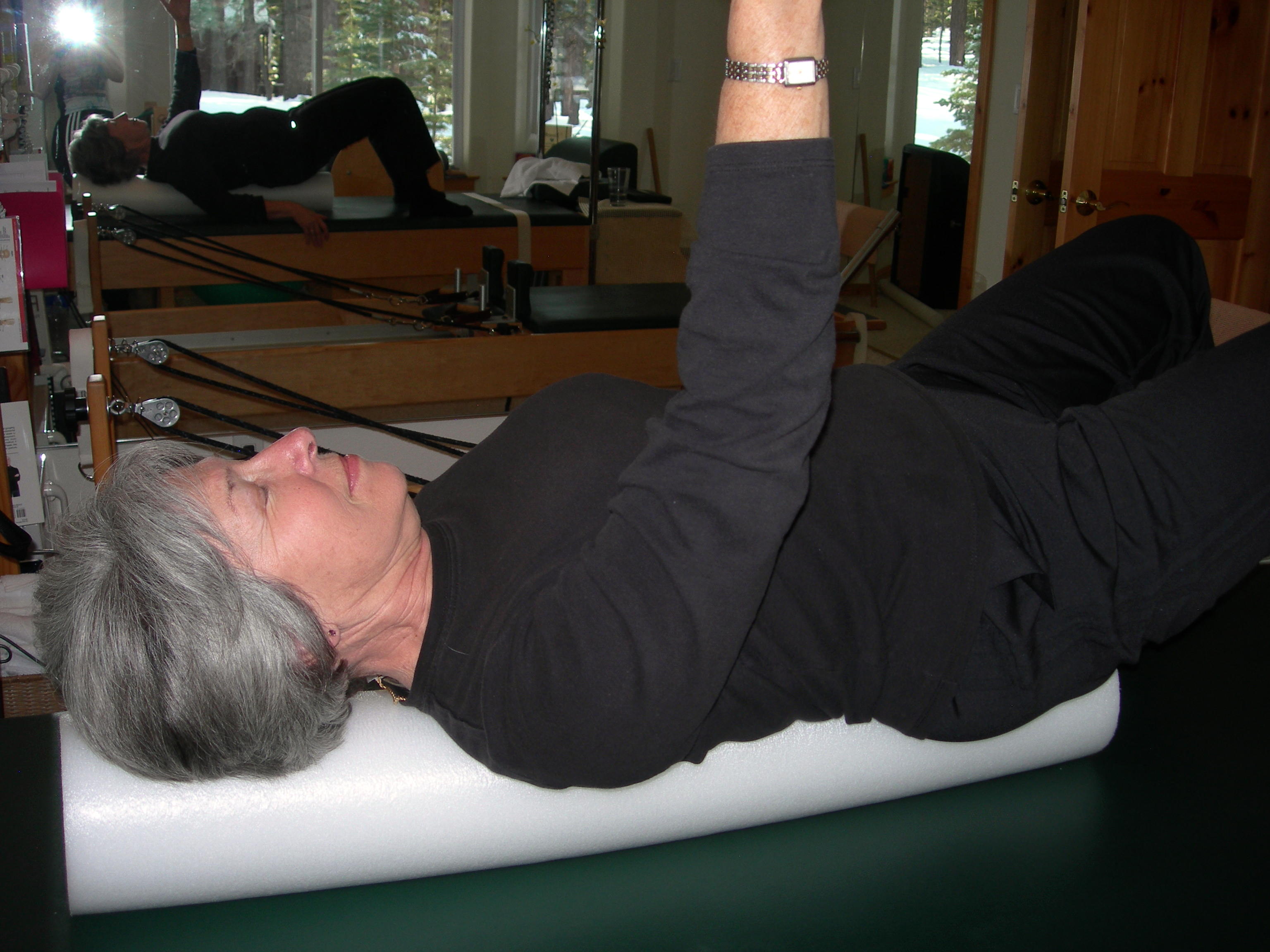 and in the air toward the ceiling and be sure your client feels the scapula either hugging the roller or on the floor and the humerus bone is weighted in the glenohumeral joint. Elevate the scapula and squeeze the shoulder toward the ear staying connected with either the roller or floor. Lower the scapula to a neutral position relaxing the upper trapezius and then further depress the scapula with the intention of activating the lower trapezius. You may need to put your finger on the target so your client feels the inferior angle of the scapula pressing into you. Once your client feels the lower trapezius activate, have her hold the position and isometrically engage it further to increase awareness. Repeat on the left side and then do both at the same time.
Exercise 2—Posterior Rotator Cuff
Have your client bend her elbows in front of her body to ninety degrees palms up as if holding a large tray. Stand behind your client and place the fingers of your left hand below the inferior angle of the right scapula and your right hand on her right shoulder with the thumb pressing into the infr aspinatus and teres minor muscles. Ask your client to externally rotate the right shoulder while holding the connection at the posterior rotator cuff and lower trapezius. The elbow has a slightly forward scooping feeling, and the ribs should not release. Repeat this exercise on the other side. After completing both sides ask your client to sit with her arms by her sides and hands on the thighs with the palms up. See if she can widen at the clavicles while pleasantly activating the posterior rotator cuff muscles without letting the ribs protrude. Another option is to have your client hold a scarf or piece of fabric around the mid-back doing the exact same exercise above so that the angle of the arm becomes clearer and provides a little resistance at the elbow.
Exercise 3—Triceps in Upside Down 100s
Performing the 100s in a prone position causes the triceps to go against gravity and activate more intensely. The depression of the scapula and firing of the posterior rotator 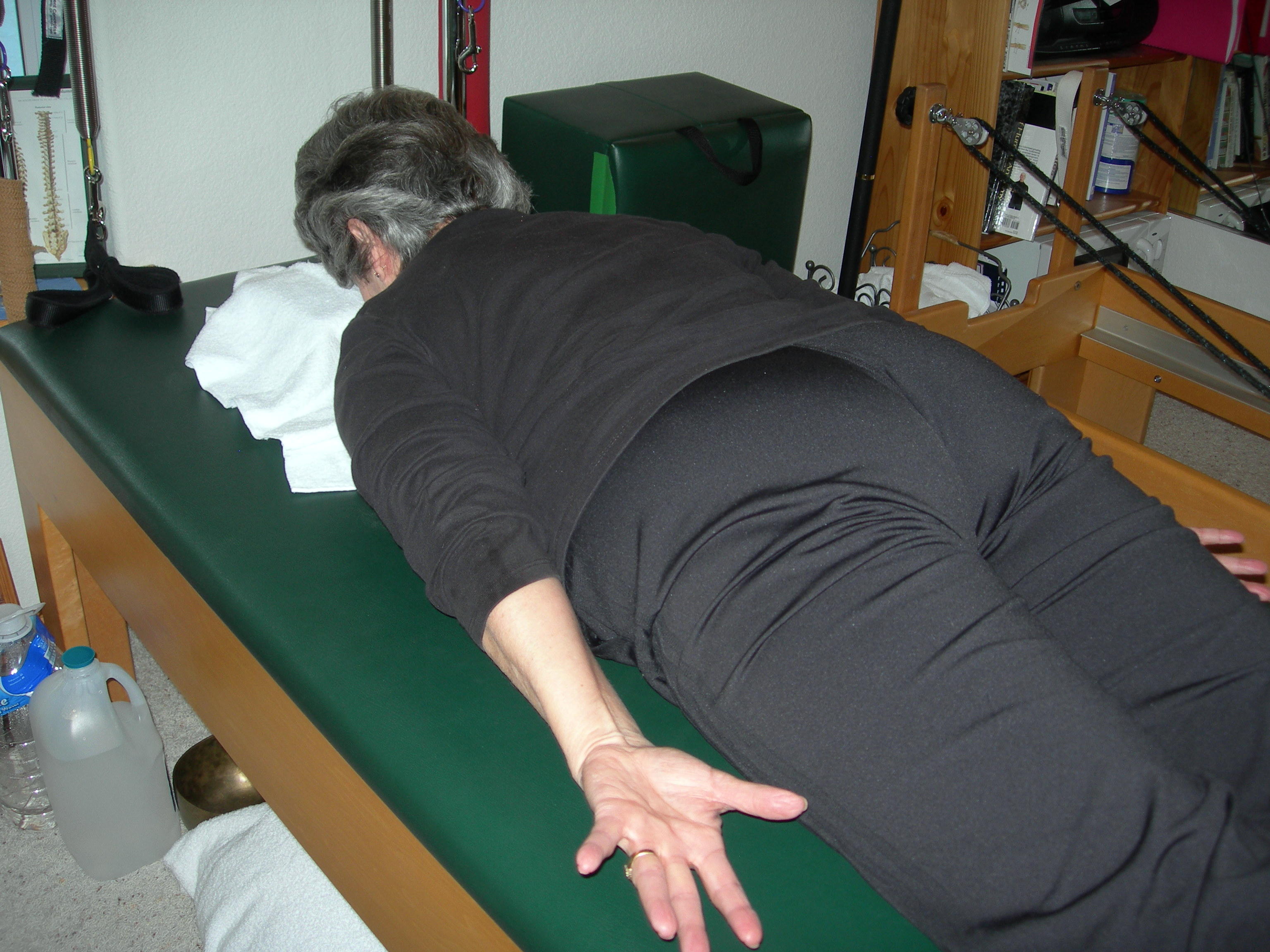 cuff can also be felt more acutely in this position. Instead of pumping the arms toward the floor, your client will now be pumping the arms to the ceiling doing the exact same 100s exercise while lying prone and scooping the belly off the floor instead of imprinting into the floor. If your client does not experience neck problems, she can activate the back extensors to lift her head an inch or two off the floor keeping the gaze down to maintain the neck alignment. When the exercise is flipped back to the normal supine position, the client is able to feel a better core connection with an increase in isometric effort.
Be sure to modify the 100s to accommodate your client’s needs.
Neck Issues 
The entire 100s exercise can be done keeping the head on the floor.
Low Back Pain
One or both feet can keep contact with the floor.

Hip Flexor Discomfort
Keep the feet on the floor or bend the knees in the air keeping them close to the chest.
Rounded Shoulders
The palms can be flipped to face the ceiling on the pump to work more external rotation of the shoulder.
 Difficulty Getting to the Floor
The 100s can be performed standing alternating legs after fifty pumps or performed seated.
Advanced Challenges
If you want to chall enge your client, try the 100s while lying vertical on a half or full foam roller. Do the first half of the exercise with one leg in the air and then exchange legs for the second half. A BOSU can also be used to challenge your client’s skills performed in a supine position with the low back on the arc of the dome.
The Hundred is a Pilates basic, but can be a coordination nightmare for some new students. Make it easier for your clients to integrate the components by breaking it down into simpler more digestible parts. As with any good building project, start with a solid foundation. Practice breath, abdominal acuity and scapular awareness to build a “power house” that is all about the core.
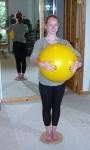 The placement of the arms should be considered in the turn. You can have your client hold her arms by her sides or in front of her as if she is holding a ball. If you have a ball that is the size of a beach ball it can be useful to actually hold the ball at the chest. Note that your client might feel more secure having her arms free when first attempting this exercise in case she loses her balance.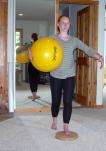

 Pilates Teacher Tips