Using Thera-bands® to Stretch the Possibilities

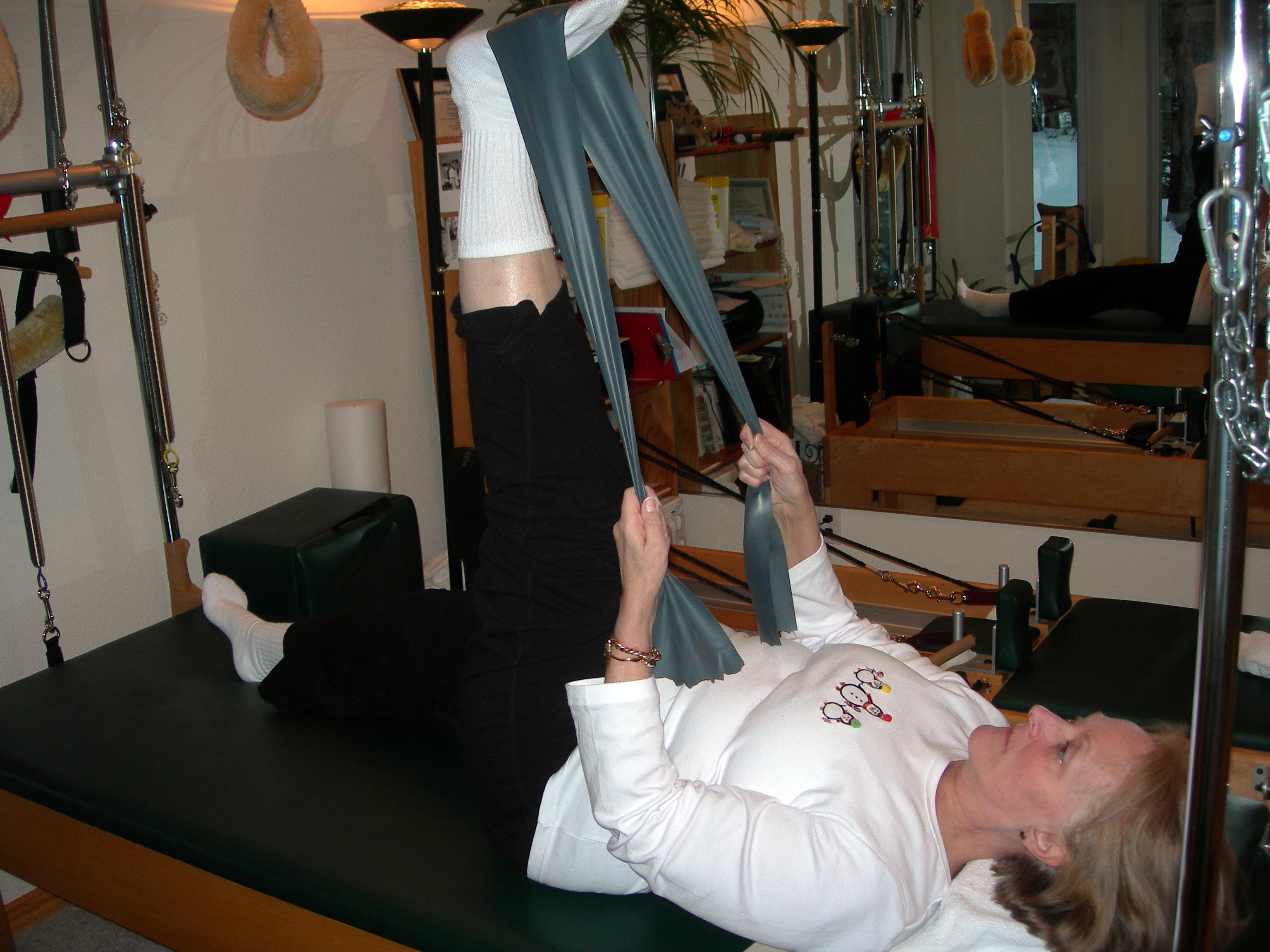
Stretching leg muscles with a Thera-band® improves flexibility in the legs, but also relieves tension in the hips and low back with minimal time and effort. The Thera-band is a resistance exercise band available in a variety of strengths indicated by color (the thicker the band the stronger the resistance). Bands are often used in physical therapy rehabilitation, since patients can maintain a consistent practice working at home and strength development can be easily monitored with the progressive color coding system. They can be purchased individually or in bulk rolls and are sold under a variety of brand names offering latex and latex-free versions. (I prefer black Cando bands.) The 50-yard roll can be cut into individual bands making it economical to provide multiple clients and mat class attendees with equipment. Although there are multiple uses for Thera-bands in an exercises program, leg stretches yield quick results and are easy for most clients to practice.      

As with any stretching program, consistency with a long-term commitment to practice is essential. Using a pain scale of 1-10 with “10” being the most intense is a good guide to check in and keep clients on track. As a general gauge, “7” on this scale means your client will be actively stretching without strain or pain, but individuals vary and some may require less intensity. Microscopic tearing of the muscle fibers is a risk for overstretching and the scar tissue that develops can lead to a decrease in muscle elasticity so “more” is not always better. If your client has strained a muscle, stretching may cause further harm, so be sure no chronic condition exists prior to starting a new routine.      

Stretching after warming the muscles is preferable so a brief warmup such as a short walk can be useful to elasticize the collagen fibers prior to stretching. Stretches should be held for thirty seconds to a minute and should evolve; as the stretch is held, the intensity diminishes requiring the limb to move into a greater range to maintain the “7” on the pain scale. These stretches will always be a bit uncomfortable (they should not be painful). Regular practice will increase range of motion and the discomfort will be experienced similarly in the newer more flexible range.      

The stretch reflex is the body’s protective tool to prevent muscle fibers from overstretching and helps protect the tendon origins and insertions from being over-pulled. When the stretch intensifies, the muscle being stretched contracts to prevent it from being forced beyond normal range. Putting the muscle being stretched in contraction helps to inhibit this reflex and can make the process safer and more comfortable. For example, when stretching the hamstrings with the Thera-band, press the leg slightly toward the floor to engage the hamstrings while pulling the band with the hands bringing the leg closer to the chest.      

Conscientious breathing will allow the body to relax with the stretch. Breathe into the tension of the stretch on the inhalation and let it go on the exhalation. This push/pull quality (pushing the limb and pulling with the band) applies to all of the following stretches and will make them feel more like pushing through peanut butter or working with taffy rather than the slack feeling of hanging in a hammock.     

Although the following descriptions indicate which hand to use to hold the band, this is a personal choice based on comfort and body limitations. For example, if your client has arthritis a two-handed hold might be more comfortable or Thera-band exercise handles  could be used to reduce grip tension.     

BAND STRETCHES   

  • Calf

The objective is to stretch the gastrocnemius and the soleus  muscles. Place the band with its full width across the metatarsals (don’t let it bunch up like a tourniquet) and hold each side of the band in either hand. Make sure you do not have a “death grip” on the band or your fingers will fatigue too quickly. Inhale—plantar flex the ankle moving the metatarsals (or ball of foot) into a demi pointe (half point) while spreading the toes. Exhale—dorsiflex the ankle and keep the toes spread. Repeat this approximately five times making sure to keep the hip of the stretching leg pressing into the floor, so the initiation of the movement starts at the core with the ankle being the end result. Variations of this stretch include ankle inversion, eversion and circles. Be careful on inversion to press from the fifth (pinky) metatarsal straight from the body without “sickleing” (shifting medially). A sickled foot is an instable ankle twist waiting to happen in the future, because it lacks strength. The objective of this exercise is to develop ankle strength and flexibility in the calf. This kind of ankle work is very useful for ballet dancers trying to achieve more articulation in their feet.  

  • Hamstrings 

The objective is to stretch the semimembranosus, semitendinosus and biceps femoris muscles. After working the ankle in the above exercise remain in the dorsiflexed position. Inhale—press the thigh toward the floor slightly to activate the hamstrings while keeping the band pulled toward the chest. Exhale—pull the leg closer to the chest while retaining some tension in the hamstrings as if still trying to lower the leg to the floor. Never “yank” on the leg. This stretch can be performed with a bent or straight knee. Both are useful and stretch either the belly of the muscle or the back of the knee. If the knee is bent, keep energy reaching through the heel toward the ceiling so the stretch remains active. This stretch is like a tug of war with the heel being one team and the ischial tuberosity (sitbone) being the other. Both sides need to actively pull on the rope.  

  • Inner Thigh/Adductors

The objective is to stretch the adductor magnusadductor longusadductor brevisgracilis and the pectineus muscles.  It is sometimes more comfortable to hold the band in the same hand as the working leg—left hand holds the band when opening the left leg so the right shoulder can stay open and relaxed on the floor. Open the leg laterally while externally rotating the hip joint. The opposite side of the pelvis should remain on the floor and the body should not roll toward the open leg. If your client is unable to keep the opposite hip down, bend and externally rotate the knee of the leg on the floor to provide a little more leverage in the counterbalance. Be sure the chest presses into the floor and the abdominal muscles are actively engaged. If the abs are not engaged and the ribs lift off the floor, your client may push the head into the floor for leverage creating a discomfort in the neck and shoulders. Use the same push/pull tension strategy as explained in the previous stretches (inhale while creating tension and exhale as the stretch increases). As the leg moves wider and externally rotates, the foot moves closer to the ipsilateral ear, but the hip should remain anchored and the pelvis square. There is a tendency for people to hike the hip in an effort to achieve greater range of motion. A hiked hip does not stretch the inner thigh more—it is like the tug of war image used before except one team walks forward and the other walks backward as they pull apart. The hip must remain down to get the oppositional energy flow.   

  • Outer Hip/Abductors

The objective of this stretch is to stretch the gluteus mediusgluteus minimus and tensor fasciae latae muscle down into the illiotibial tract. Move the leg medially across the center of the body until the hip slightly lifts off the floor, but not so much that a full twist occurs in the lumbar region. It is not important for the leg to reach across the body very far, the stretch occurs when the hip pulls back into the floor (the foot in the band remains held in space and the hip pulls downward in opposition). Having the band in the opposite hand of the leg that is stretching contributes to this opposition. Inhale—pull on the band slightly and press the leg laterally into the band to create tension. Exhale—keep the foot held in space and drop the hip toward the floor using the internal obliques to rotate the spine. Be sure to also lengthen the waist by pulling the head and tailbone apart.     

  • Circles

The circumduction of the hip joint reviews all the previous stretches. The image of an ice cream cone can be a useful tool to mimic the conical pathway. The emphasis should be to press the hip into the floor where the ice cream would go at the tip, and then draw the lip of the cone either on the ceiling or on the walls if your client has greater range. Keep that feeling of pushing through taffy and guide your client to make sure that each hamstring/adductor/abductor position previously stretched is addressed. The leg must externally rotate each time the leg moves laterally to guide the ball in the socket of the hip joint comfortably. Correct the pathway or limit the range if your client experiences clicking in the hip joint.  Be sure to circle both clockwise and counter-clockwise three to five times each.   

  • Splits

The objective is to energize and lengthen both legs while simultaneously activating the core. The feeling should be like doing splits on the ceiling. Hold the band in both hands with an underhanded grip to encourage the shoulders to stay down. Split the legs apart with the lower leg off the floor and lift the head off the floor as well (if your client has neck discomfort keep the head on the floor). Inhale—press the thigh into the band as in the previous hamstring stretch. Exhale—pull the top leg slightly toward the chest while preventing the hip from hiking and deepen the belly scoop. Draw in the transversus abdominis deeper on each exhalation.  Hold for three to five breath cycles.

The improved range of motion from regular stretching may help decrease injuries by preparing the body for a variety of activities.   Mayo Clinic physical medicine and rehabilitation specialist Edward R. Laskowski, M.D. says,   

 “If your joints are not able to go through their full range of motion because of muscle tightness, sports and exercise activities may put an excessive load on the tissue and contribute to injury. Think of a runner with tight calf muscles and a tight Achilles tendon running up a hill. This activity requires that the ankle bend up to accommodate the slope of the hill. But if it can’t because of tightness, the runner may be at risk of getting Achilles tendon irritation and injury.”    

There is a correlation between leg stretching and improved posture in the spine. Tight hamstrings will encourage a posterior pelvic tilt eliminating the necessary lumbar curve for lifted posture (see article The Use of Imagery to Help Your Client Find Lift Through the Core). The lumbar lift and core stability available in a neutral pelvic placement is diminished with the downward pressure of the tucked pelvis. If your client experiences low back pain, leg stretching with a band may be one component in a program to improve this condition.      

Regular leg stretching with Thera-bands can improve mobilization at the hip and ankle joints better preparing your clients for whatever activities they choose. Bands are portable and require almost no storage space and are great for traveling. The leg stretch series also increases blood flow, which facilitates the body’s ability to heal and repair itself. Have your client notice the energy flow into the stretched leg prior to switching sides. Your client should be able to perceive the asymmetry of the stretched and unstretched leg. Noticing an immediate difference for the effort exerted is a great motivation to keep stretching and will keep your client consistently practicing at home. Better posture, improved range of motion, healthy blood flow…what’s not to love!

Coordination and Balance through Cross-Crawling

The coordination training we received as children through the developmental stage of crawling set the foundation for right and left brain hemisphere communication. Since the right hemisphere of the brain controls the muscles on the left side of the body and visa versa, the oppositional nature of arm and leg coordination during crawling activates the nerves across the corpus callosum connecting the two brain hemispheres. As adults, the continued integration of the two sides can result in better coordination, balance and efficient movement. The nerve networks can be stimulated and developed through cross-crawling exercises that utilize oppositional movement patterns.

Although you could crawl on the floor, the “crawling” in cross-crawling does not mean you have to replicate the movement of babies.  The main intention of every exercise is to use the opposing arm and leg. The exercises can be performed in supine, quadruped, sitting, or standing positions. It is also beneficial to try variations that move the limbs in the sagittal, coronal or transverse planes for better spatial awareness.

The following are some samples, but certainly not all the possible options. Be creative and come up with your own choreography that serves the needs of your clients. Do a few repetitions of each action focusing on the ones that are most difficult for your client to achieve. A more challenging combination is to string several different variations in a row requiring quicker changes, rather than repeating one exercise several times. Even harder is to do a combination of several different variations and then decrease the time it takes to complete the entire set.

If your client has difficulty performing cross-crawl exercises, that is an indication that coordination skills are lacking and the exercises should be added to your client’s daily practice. The senior population is one that can especially benefit by preventing falls (and possible breaks) though improved balance and coordination. In addition, clients with a homolateral gait (monkey walk) where the same arm and leg swing together can also benefit. I started doing these exercises with one of my clients who has Parkinson’s and he found them to be very useful in improving his gait and spatial awareness.

CROSS-CRAWL EXERCISES

Supine:

1) Lie of the floor with knees bent and feet flat of the floor. Cross the right elbow to touch the left knee. Return to the starting position. Repeat on the opposite side touching the left elbow to the right knee.

2) Lie flat on the floor with straight legs together and straight arms by your sides. Slide open the right arm along the floor and left leg away from the midline along the floor at the same time and return them back to the center starting position (similar to the action of making a snow angel). Repeat on the other side sliding the left arm and right leg away and back.

Quadruped:

1) Start on all fours with hands below the shoulders and your face looking toward the floor. Simultaneously reach the left arm parallel to the floor by your ear and right leg off the floor in the opposite direction behind you parallel to the floor. Return them at the same time and repeat the opposite side using the right arm and left leg.

2) Try the above exercise with variations. Reach the left arm to the side (rather than overhead) parallel to the floor and take the right leg either back or sideways off the floor to the opposite side like airplane wings (leg side off the floor is more challenging to core strength). Repeat the opposite side using the right arm and left leg.

Sitting:

1) Sit in a chair with feet flat on the floor and arms down by your sides. Step the left foot forward on the floor and reach the right arm out in front of you parallel to the floor. Return to the starting position and then reach the right foot and left arm. This exercise could also be performed with the left foot stepping to the side and the right arm reaching laterally to the opposite side or the left arm reaching back while tucking the right leg under the chair (reaching behind would not be recommended for someone with shoulder issues).

2) Sit in a chair with feet flat on the floor and arms down by your side. Simultaneously step the left foot over the right foot onto the floor, take the right hand and place it on the left hip, and touch the left index finger to the nose. Return to the starting neutral position. Repeat to the other side moving the right foot across the left foot, left hand to right hip and right index finger on your nose.

Standing:

1) Stand with legs hip distance apart and arms by your sides. Raise the right arm reaching toward the ceiling while simultaneously bending the left knee and raising the knee off the floor in a marching position. Return to the starting position. Do the opposite side raising the left arm and right knee.

2) Stand with legs hip distance apart and arms by your sides. Touch the right elbow to the left knee while simultaneously touching the back of your head with the palm of your left hand. Return to the starting position. Do the opposite side touching the left elbow to the right knee while simultaneously touching the back of your head with the palm of your right hand.

 ________________________

Balance can be improved in the senior population not only with cross-crawling exercises, but also exercises that cross the midline to transfer weight from one leg to another. One of my clients was going to quit her line dancing class because she was frustrated with her poor balance negatively affecting the quick transitions required by the choreography. After about a month and a half of practicing her exercises daily at home, the transition was remarkable! She no longer had problems with her balance and was able to perform more complicated steps. She would have missed out on something fun that provided exercise and social contact had she not made a commitment to practicing.

CROSSING THE MIDLINE

The “jazz square” is useful for practicing weight transfer from one leg to the other crossing the midline. Some people teach the jazz square starting with a forward step, but crossing the midline first may be more useful to practice weight transference.

Jazz Square:

Start standing with legs together. Cross the right leg over the left and transfer the weight to the right foot. Pick up the left back leg and step backward. Shift your weight right to step sideways onto the right leg. Step the left leg forward. The weight will be on the left leg (instead of on two feet as in the beginning) and the step begins again with the right leg crossing over the left to transfer the weight to the right foot. Repeat to the same side several times. Try it on the other side starting with the left crossing over the right, step back with the right, shift side with the left foot and step forward with the right foot.

Switching sides can add a level of challenge. When changing sides the last move in the step is dropped. There are a total of four moves in the step (cross, back, side, front). Perform the jazz square three times with the right foot crossing first over the left foot first. On the fourth set only do the first three moves (cross, back, side). This will put the weight on the right foot. Start the jazz square using the left foot crossing over the right for three sets. On the fourth set only do the first three moves (cross, back, side). This will put the weight on the left foot and the pattern can begin again.

 ________________________

Coordination and balance are learned skills that begin in our earliest developmental stages. These abilities are perfected through movement challenges and practice. The body in its effort to be efficient will provide less wiring for these activities if they are no longer being used. As we age our activities must reflect a movement vocabulary commensurate with the quality of life we wish to maintain. Cross-crawling exercises that integrate brain function can improve coordination and balance making us more alert and aware. Once again the old adage of “use if or lose it” rings true.

Centering on Rotator Discs

Rotator discs are a great tool to improve dancers’ pirouette form and are also useful for non-dancers to experience postural alignment along a center axis. Although proper alignment prevents injuries and allows our bodies to move most efficiently, it can be challenging to maintain this interlocking jigsaw-like relationship when put in motion. A spinning motion along a central axis using rotator discs can proprioceptively illustrate an understanding of alignment better than words ever could. Your client will either maintain balance and have a conscious experience of a “center” line through the body like that of the lead of a pencil, or she will lose balance and have a warping disjointed experience demonstrating that posture was not maintained.

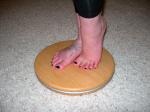
Rotator discs come in different sizes and are basically two circular plates with ball bearings in the center. You will want to choose a size that is large enough for your client to stand on with both feet side by side—12” is generally good choice. In preparation for this exercise, be sure your client has a clear understanding of proper alignment in a static position and how to engage her core muscles. (See article “The Use of Imagery to Help Your Client Find Lift Through the Core.”) Do not put any person into this exercise who has difficulty balancing on one leg, as the exercise would be too advanced. Make sure to spot your client in case she loses her balance, and allow plenty of floor space around the disc free from any obstacles.

Start your client with one foot on the floor and the other foot placed on the disc. An outside or en dehors turn has the right foot on the disc and requires a counterclockwise turn with the left foot pushing off the floor and then stepping onto the disc. For an inside or en dedans turn to the right, the right foot starts on the disc with the left foot pushing off the floor and turns clockwise. Use the back foot to push off the floor providing momentum for the turn and step quickly onto the disc with both feet.

Applying too much force will throw your client off-balance or increase the revolutions to possibly make your client dizzy. It is best to start with minimal force until your client gets used to how much pressure to apply against the floor. Have your client continue to turn until the disc slows and comes to a stop. Be sure to practice both sides and change directions every few turns. If your client is a dancer, have her practice “spotting” in the turn.

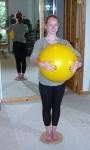
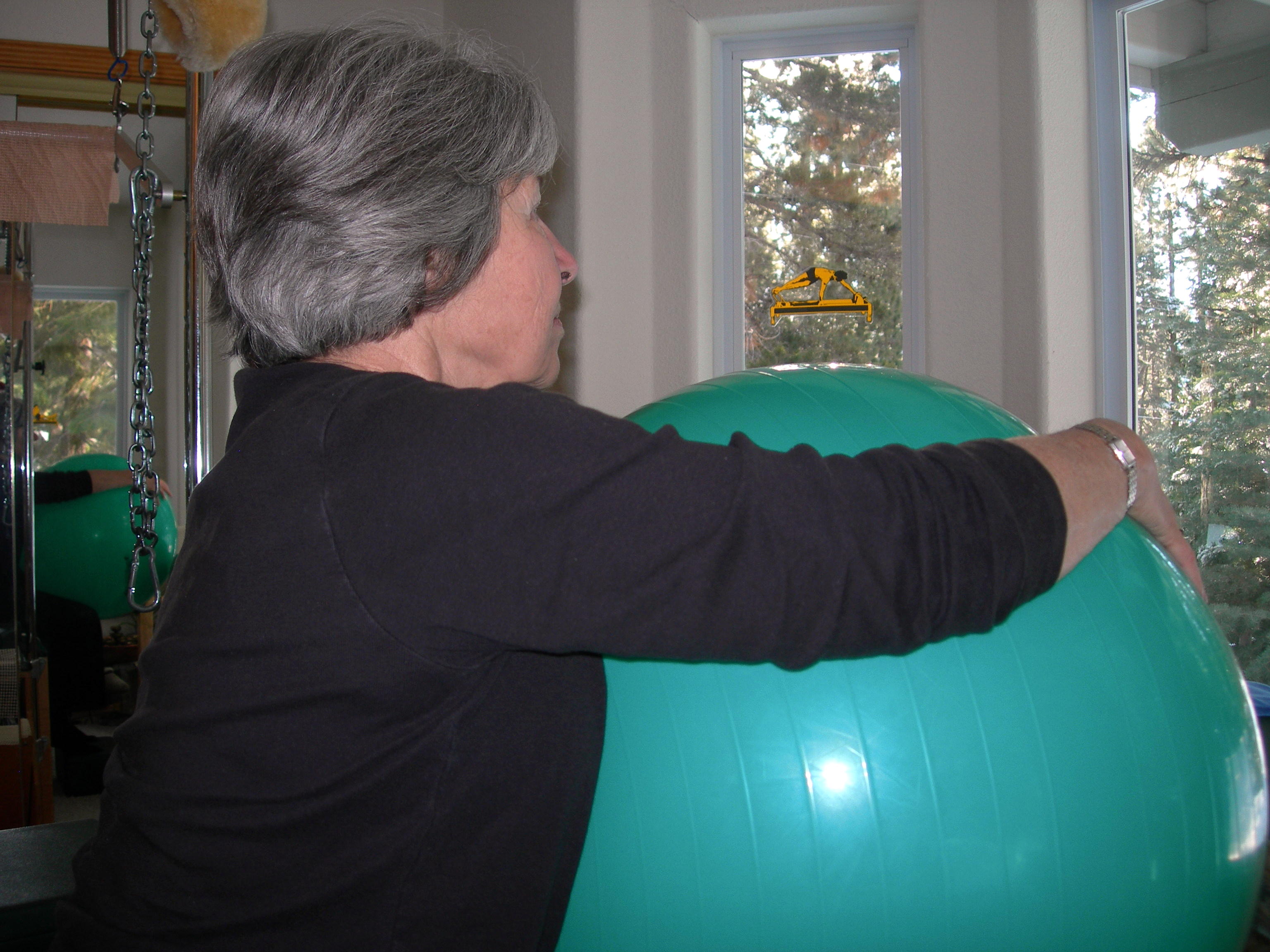
Pru Turn 2The placement of the arms should be considered in the turn. You can have your client hold her arms by her sides or in front of her as if she is holding a ball. If you have a ball that is the size of a beach ball it can be useful to actually hold the ball at the chest. Note that your client might feel more secure having her arms free when first attempting this exercise in case she loses her balance.
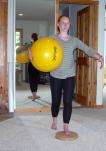
If your client is a dancer, the arm placement can be more complicated with the preparatory position in ballet 3rd position moving to 1st position in the turn. Dancers can sometimes lose the volume of 1st position when turning, so holding the ball can give your client a sense of width between the elbows. Make sure that your client anchors her scapulae as well so that the arms are connected to the back with strength.

inside or en dedans turn

inside or en dedans turn to the left

The ball should be placed in the “following” arm, not the lead arm. The arm that follows into the turn is more significant since it provides the “snapping in” effect providing momentum. If this arm is not lively and connected into the back the turn will lose energy and stability. Practicing this movement first with the ball patterns the arm to move toward the midline of the body with volume and proper timing.

Rather than just standing on the rotator disc with both feet flat, dancers can progress to having the working leg in forced arch, coupé and then passé. As the level of difficulty increases, be careful to decrease the torque exerted against the floor or the turn will be difficult to maintain. Parallel and turned out positions are both suitable for practice, but parallel may be preferable for the general public or contemporary dancers.

forced arch foot placement

forced arch foot placement

Rotator discs can effectively teach the concept of center. Your client must stabilize her core (the center of gravity) in addition to holding postural alignment (center axis). When using a rotator disc, the central axis of the body is like the pole in tetherball and the turning action represents the ball going around the pole. It is essential to have the body aligned or the turn will wobble like a tetherball would around a bent pole. Your client receives immediate feedback as to her success and can adjust accordingly. The experience of turning on the rotator disc becomes her instructor and teaches the concept of center better than your explanation ever could.

Reward Your Client with Tibetan Singing Bowls

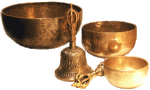
Tibetan bowlsTibetan Singing Bowls are a great option for finishing a session with your client to leave her feeling centered, relaxed, and rewarded. These bowls from the Himalayan region are made from a combination of metals (bronze alloy, copper, tin, zinc, iron and sometimes other metals depending upon the age of the bowl) and produce vibrating tones when struck or circled along the circumference of the bowl’s rim with a mallet. They are used in yoga classes, holistic sound therapy, chakra re-balancing and personal meditation. Singing bowls produce a calming effect and reinforce the concept of living in the present moment.

The pitch varies on the size and thickness of the bowl, and is played with a wooden stick that creates friction around the rim of the bowl like a wet finger would around a wineglass. The sound changes when using felt covered strikers on the side of the bowl giving it a lower tone. A less metallic sound is also possible using a suede covered mallet. Bowls come in small, medium and large sizes with and without decoration. It is easy to learn how to play them and requires only a quick demonstration on the technique of holding the mallet and how to apply pressure to the side of the bowl.

When the bowls are placed on the chakras they allow the individual to hone in on the energy centers of the body. Although each note is linked to a chakra, relaxation and centering can occur whether or not this pattern is followed. When you buy a bowl, it should specify what notes are played with the striker and mallet. Starting at the 1stchakra the notes correspond in ascending order as C, D, E, F, G, A, and B at the 7thchakra. Although it is helpful to have an understanding of the chakra systems to direct one’s energy and attention, the balancing effect will take place regardless. I tend to place my Tibetan Singing Bowls on a client by size rather than the specific note rendered since the notes played blend together harmoniously.

The calming vibration takes the mind from a cerebral analytical state to an emotional experiential state effectively diminishing internal mind chatter. For those “Type A” personalities, it is truly a gift to get out of one’s head and experience the state of “being-ness.” The opportunity to slow down and recover after a physical workout helps your client transition into the next activity of the day with relaxation and greater ability to focus.

I have also used bowls to finish a group mat class with a guided meditation and have received positive feedback from students. I place the bowls in the center of the room and have the class lie on the floor on their mats like spokes on a wheel with their heads toward the center to clearly hear the sounds. I have even used my bowls in the hospital when my mother was recovering from a traumatic surgery (obviously not near the wound). Now when I go to visit her, she still asks me to bring them because she wants to repeat the relaxing experience.

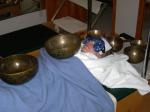
Blog photoIf there is time at the end of a session I will sometimes do what I call the “spa finish.” I have the client lie supine on the Cadillac with legs propped up on the short box from the Reformer if it is more comfortable. I heat a neck wrap in a microwave and place it around the client’s neck with a lavender eye-cover (ask if lavender is okay—not everyone likes it). I will sometimes cover the person with a heavy blanket to create a swaddling cocoon. I vary the placement of the bowls and how I play them depending on the emotional state of my client using my intuition as a guide. Striking a bowl under the table, one on the chest and playing another one above the body can create a tiered-effect. Occasionally wait for the vibration to stop before playing the next bowl. This silence can align the client with stillness and greater awareness of the present moment.

Pilates is highly adaptable to all skill-levels, but should appropriately challenge your client physically and mentally. After providing your client with this stimulating movement experience, it is helpful to provide some kind of relaxing or centering ritual to finish. There are many ways to end a session, but Tibetan Singing Bowls just might leave your client singing your praises.

Spice Up Your Pilates Palate with GYROTONIC® Exercise

Odds are good that if you are teaching Pilates you have heard of the GYROTONIC®Gyromethod, but you might not be familiar with how it can expand and improve your perspective as a Pilates instructor. There are some people who tout the merits of each method as being the “be all, end all” movement experience. Personally, I tend to gravitate toward the philosophy that the more tools you have, the better equipped you are to assist your client’s needs. Even if you do not plan to get certified in the GYROTONIC® method, it is worthwhile to better understand what it is about and to try a session on your own body to judge for yourself.
The GYROTONIC® method is the brilliant creation devised by Juliu Horvath utilizing three-dimensional movement with resistance. Although one of my friends affectionately refers to it as “gin and tonic” the name actually derives from “gyro” meaning a circle and “tonic” referring to something that is good for you. There are several pieces of equipment in the GYROTONIC EXPANSION SYSTEM®, but the most commonly used piece found in studios is The Pulley Tower. This apparatus consists of two handled wheels attached to a movable bench that sets next to a tower with a weight and pulley system with upper and lower resistance straps.

The genius of this system is that it allows for freedom of movement in all planes in space, while calling upon strength with flexibility to perform the exercises with fluidity and attention to one’s breath. The joints of the body experience lengthened range of motion, and the exercises with handled wheels allow the spine to spiral with complex articulation. This type of spiraling is not practiced using typical push/pull gym equipment, and makes it an ideal exercise method for golfers hoping to improve their swing.

The more extreme demand for shoulder mobility in some of the wheel exercises have allowed my clients with residual problems from shoulder surgeries or injuries to make remarkable improvements in their strength and flexibility. Over time, one of my clients who could barely open her arm laterally after completing physical therapy resumed full range of motion. In the hamstring series, the participant lies supine with legs supported in straps allowing for non-impact full range of hip motion. Several of my clients have commented on how much they enjoy the supported range of motion, and have been able to move from their hip joints without tension.

The GYROTONIC® method observes how energy is directed in the body and physical holding patterns from past injuries can be identified (rather than the more placement-driven viewpoint of Pilates). Physical issues tend to reside where there is a break in the flow of energy, so being able to observe this is useful for honing in on areas of concern. Similar to Pilates, the exercises in the GYROTONIC® method initiate movement from the core, and then radiate the energy outward through the limbs. An ex-dancer client enjoys the rhythmic quality of the movement and says that the exercises can sometimes feel like dancing.

The principles found in GYROTONIC® exercises can also be performed without equipment (similar to Pilates matwork) using Mr. Horvath’s method called GYROKINESIS®. These specialized exercises are done sitting on a stool or lying on a mat and can be performed separately or complimentarily with GYROTONIC® exercises.

From my perspective, the similarities between the GYROTONIC® method and Pilates include core driven movement initiation, eccentric strength, attention to breath and its integration with exercises, and the importance of mental participation for body function. Exercises from both methods supply the necessary tools to address and correct dysfunctional compensatory injury patterns through non-impact exercise. Exercises are adaptable to all physical issues, skill levels and body types.

My experience has found Pilates to be more user-friendly and better suited to introductory back injury rehabilitation, while GYROTONIC® exercises mimics our more “real life” three-dimensional complex movement experiences. Pilates seeks balance in the body with bi-lateral development along the sagittal, transversal and coronal planes. GYROTONIC® exercise explores how the body moves through these planes of space with maximum range.

Even though Pilates is now a recognized mainstream exercise method, its widespread popularity did not occur when Jospeh Pilates was alive. Currently GYROTONIC® exercise is not as widely recognized as Pilates, but its versatility and functionality should catapult it into the public arena before long. GYROTONIC® exercise is an “alive” method, constantly evolving and improving under the tutelage of its originator Juliu Horvath. Even if you do not plan to teach the GYROTONIC® method, studying with first generation teachers is a golden opportunity that should not be missed.

GYROTONIC®, GYROTONIC EXPANSION SYSTEM® and GYROKINESIS® are registered
trademarks of Gyrotonic Sales Corp and are used with their permission.

Addressing Trigger Points to Facilitate Range of Motion

It is common knowledge that stretching can help elongate muscles and reduce stiffness, but there are cases where stretching can actually worsen the situation and increase pain. Stretching a muscle that is already “knotted” and is pulled taut can further irritate it. It can be helpful to release the trigger point (knot) prior to stretching for ease of movement and better range of motion. Although you can refer your client to a massage therapist specializing in myofascial trigger point work, using trigger point release in a Pilates session can expedite improvement for immediate results.

The pioneers of trigger point research, Janet G. Travell, M.D. and David G. Simmons, M.D., define a trigger point as “a highly irritable localized spot of exquisite tenderness in a nodule in a palpable taut band of muscle tissue.” Since we have multiple muscle fibers and these fibers are bundled together to serve a united purpose of joint movement, some of the fibers can remain in a contracted position without all being affected. Releasing the culprits causing irritation can allow the group to work better as a whole. The nodule is very tender to the touch and will elicit a response of discomfort and/or pain when touched depending upon its severity. The pain can be localized to the trigger point or referred to a seemingly unrelated location.

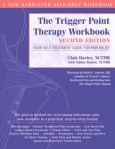
trigger point book picAn excellent user-friendly resource for studio or home use is The Trigger Point Therapy Workbook: Your Self-Treatment Guide for Pain Relief by Clair Davies. This manual takes you through the process of how to find and release the trigger point with diagrams depicting the areas of referred pain. If you want your client to consistently address trigger point release at home, it can be helpful to show your client a picture of the affected muscle and where the referred pain can be found.

Although pressing your fingers into the affected spot can release the tightness, there are tools available that can make this process easier. A tennis ball, Thera Cane, Wooden Knobble, myofascial release balls or foam rollers can all be useful. Doing the work without equipment can improve your ability to find the trigger points by touch, but over time using tools can prevent excessive wear and tear on your hands. In addition, the tools encourage more consistent practice, because your clients are able to use them at home.

Although it seems counterintuitive to press on a spot that provokes pain, the discomfort diminishes once the trigger point has been loosened. The muscle fibers are holding for a protective purpose, which may have been applicable during a situation of stress, excessive load or trauma. Once that situation has changed, the muscle sometimes needs an outside stimulus to break the loop.

It is helpful to have an ongoing dialogue with your client during trigger point release. Since everyone has a different level of pain tolerance, it is worthwhile to have your client communicate with you throughout the process. Let your client know that the pain should register about a “7” on a scale of 1-10 with 10 being the most intense. As you press on the trigger point, you can have your client count you in “5, 6, 7” so you don’t push beyond the appropriate level of tolerance. If you press in the intensity of a 9 or 10, you will not have good results because the body will resist, and, if you do not press hard enough, there will be insufficient pressure for release to occur.

You can also coach your client to inhale and tighten the muscle breathing into the pain and then relax the muscle during the exhalation. Instead of holding the trigger point consistently throughout, pushing on the trigger point on the inhalation and releasing pressure on the exhalation can at times make it easier for the client to let go. You know if the process is working when you continue to press with the same intensity and your client’s perception of the intensity decreases. It also gives the client a level of comfort to know that going INTO the discomfort has actually DECREASED the feeling of pain providing a positive experience.

Trigger point release in a Pilates session is a means to an end. Your objective is to release the offending trigger points, so that the chosen exercise can be performed with greater ease and range of motion. If the work required is extensive, refer your client to a massage therapist trained in this method. Although it does take time to get the “feel” for trigger points, knowing how to release them can provide immediate benefits to your clients.

Help for Sciatic Pain

If your client complains of pain shooting down the back of her leg accompanied by tingling, or numbness, she may be experiencing symptoms of sciatica. Sciatica involves a compression or irritation of the sciatic nerve. The pain can occur for a variety of reasons, including a herniated disc pressing on the nerve roots coming out of the spinal cord into the lumbar region, or a tight piriformis muscle pressing into the sciatic nerve that feeds down into the leg. Although the symptoms may go away over time, there are exercises and stretches available to help alleviate discomfort.

 Pilates exercises that strengthen the core and stabilize the pelvis in neutral placement can decrease the downward pressure on the intervertebral discs. Think about the intervertebral discs like fluffy marshmallows. You can squish them and watch the sides protrude or you can pull your fingers apart to return them to their original shape. Being able to sit tall with muscular support for the low back in a neutral pelvis position gives you better odds at decompressing the irritated nerves if the discs bulge.

 Positions requiring spinal flexion can sometimes increase symptoms. Emphasize core strength in neutral pelvis placement found in sitting, standing, side lying, quadruped, or neutral pelvis supine positions such as footwork on the Reformer. Prolonged standing or sitting can also increase symptoms, so try not to stay in one position too long. Be sure that your client understands how to activate the pelvic floor, transversus abdominis and lumbar multifidi. Most people have never consciously tried to contract these muscles, and need to first find them in order to activate them for pelvic stabilization.

 If your client is not used to sitting up tall, activating postural muscles can cause fatigue. When her back gets tired, make sure she reaches over to grab her ankles and takes a few deep breaths to relieve any tension created in the back to prevent muscle spasms. (See post The Use of Imagery to Help Your Client Find Lift Through the Core.) Sitting in a chair with good back support can also help.

 If sciatica symptoms are present when getting out of the car, you can suggest trying a towel “tootsie roll.” Fold a small bath towel in half lengthwise and roll it up as you would a yoga mat into a tootsie roll shape. Place the towel support at the crease of the car seat to prevent the pelvis from shifting out of neutral into a posterior tilt. This roll can also be placed on a chair for additional support. Be sure that your client understands that the towel tootsie roll is used ONLY at the base of the sacrum (where the crease of the seat and backrest meet) and NOT to be placed at the lumbar spine. The towel’s purpose is to give the pelvis a feeling of rocket boosters at the base of the pelvis shifting the weight slightly forward on the ischial tuberosities, not to force more curve in the low back.

 Tightness in the piriformis muscle can also cause sciatic pain since the pathway from the origin and insertion of the muscle crosses over the sciatic nerve. Improving flexibility through regular stretching may also help relieve sciatic symptoms. The pretzel stretch is useful for stretching the piriformis and can be performed with modifications. 

Directions for the Pretzel Stretch

Lie on your back with bent knees with both feet on the floor. Place your right ankle over the left knee and clasp the back of the left thigh with both hands and pull the left thigh toward the chest. Keeping the left thigh toward the chest, inhale and push the left thigh away from the chest while simultaneously pulling the clasped hands behind the thigh toward you. The leg doesn’t go anywhere, but muscle tension is created. Exhale releasing this muscle tension and pull the left leg closer to the chest. As you do the above, it is very important to keep the sitbones (ischial tuberosities) reaching toward the floor and try to maintain the lumbar curve found in neutral pelvis. This “sitting” toward the floor feeling creates opposition in the stretch providing a better pull. You can also rock the stretch slightly from side to side. Hold the stretch for around one minute and then repeat it to the opposite side. Sitting in a chair can modify this exercise for those unable to stretch on the floor with the emphasis placed on sending the tailbone back and lifting the chest up and forward.

Although some clients will need to see a doctor for their sciatic symptoms, the improved core strength and flexibility provided by Pilates exercises may decrease sciatic discomfort. As we are not stationary beings, understanding how to stabilize the core as we move through space pursuing our daily activities can help prevent aggravation. With the proper knowledge and consistently applied tools, your client can self-correct if she slips into old habits. Although exercise alone may not alleviate sciatic symptoms, the pain experienced by sciatica is often a great motivator for even the most committed couch potato to give it a try.

Helping your Parkinson’s Client with Frozen Gait

Some clients with Parkinson’s disease (PD)  may experience difficulty moving from one piece of Pilates equipment to another after completing an exercise.  This inability to propel the feet is a symptom of PD and is commonly referred to as “frozen gait.”  With most clients, their unconscious mind gives them the commands necessary for their body to move and perform the next action. With PD, this automatic feature can sometimes be interrupted.

 Fortunately, we often can help our client “reboot” the system with a conscious command originating from another part of the brain.  Once the body makes the first move, another part of the brain takes over for locomotion—like the jumpstart of a car battery getting the engine going again.

Mayo Clinic Parkinson Specialist J. Eric Ahlskog, Ph.D., M.D. provides some possible suggestions you may make to your client in The Parkinson’s Disease Treatment Book

  • Swing one leg forward.  Think about swinging the leg rather than walking.  Start with a long leg swing that will place that leg far in front of you (but not so far that you fall).
  • Try goose-stepping. This was the marching gait of German soldiers.  They would stiffly lock their knees and march by taking long stiff steps.  Envision what they looked like and keep this thought as you take your first step.
  • Think about a drum major’s marching step, raising one leg straight up off the ground before placing it forward.  Envision that same movement when you get stuck.
  • Think about a drill sergeant’s marching cadence:  “one-two, one-two, one-two…” You might even count out loud.  This might get you started and help you mentally envision a marching step.
  • Thinking of a certain musical tune may be helpful. For example, a gliding first step may come more easily if you hum “Blue Danube” in your mind and imagine a ballroom dancer gliding in that same way.  A boogie or rock and roll tune that brings a dance step to mind may also work.
  • Find a target on the floor and step on it.  Sometimes people imagine they are stepping on a fly in front of them.  Look for an imaginary fly on the ground and try to crush it; this may get your gait started.
  • A variation on this involves using a laser pointer to create a target to step on. If you point the laser light 1-2 feet in front of you and then think about stepping on that tiny lighted spot that may get you going.  Laser pointers are used by professors and lecturers and may be purchased at bookstores.

 Consult with your client to see what tool works best.  After your client begins moving, it is also common for a PD client to have difficulty maintaining the tempo, or to freeze again upon slowing down or stopping. One of my clients will put his hand on his wife’s shoulder when they are walking together to maintain a sense of rhythm in his gait, which he at times loses on his own. Impressively, he still skis and will count the ski lift towers and sing a song to himself like “one, two, three…and” to get ready to initiate push off from the ski lift and transfer his weight over his legs.  This counting also becomes useful in Pilates exercises, such as with leg circles in the straps on the Reformer, to maintain fluid movement.  If you think that your client is experiencing inconsistent or stilted movement, try leading with your voice “circle down 1,2,3,4, circle up 1,2,3,4” to maintain the rhythmic feel.

Despite all your clever tricks, sometimes nothing works.  When this happens, it is often a medication issue. Your client generally knows from taking medication when “on” and “off” efficacy times occur relative to the dosage and the time the medication was taken.  Schedule your appointments based on medication peak performance to get the most out of a session.

Brent Anderson PhD, PT, OCS of Polestar Pilates has a great recommendation for working with PD clients.  He suggests that you provide a, “successful movement experience that exceeds their expectation.” PD clients may not always have the perfect Pilates form, but acknowledging and praising what they can do will empower them to recognize their own accomplishments and strive for success in the future. 

 A working relationship with a PD client can be challenging for a Pilates instructor, but it is extremely rewarding when your client experiences improved function.  Understanding the common symptoms, such as freezing gait, can help you know what to expect and to work with greater patience.


The Use of Imagery to Help Your Client Find Lift Through the Core

Many clients struggle with accessing the muscles necessary for core engagement and postural alignment. The use of imagery or metaphors can help your client find the proper form. Instead of taking a client through the specific steps of muscular activation, try suggesting that your client concentrate on images, such as a diamond, marble or golf ball, for example. You can easily refer to these chosen images later and your meaning will be understood without excessive verbiage.

To begin, have the client sit on a chair in a neutral pelvis position with weight slightly forward on the ischial tuberosities (sitbones) and the weight solidly on the feet. Ask your client to find the feeling of being a chair with its weight distributed equally between the sit bones and the feet as a chair would have four points of equal contact against the floor. Then suggest that your client imagine that an arrow has been shot sideways (coronal plane) through the pelvis and another one from front to back (sagittal plane) about 2-3 inches below the navel (umbillicus). Where those arrows intersect in the center, ask your client to visualize a diamond as if it were cradled and held up between prongs like in a ring. Keep the diamond lifted and suspended from all sides.

Then have the client lift the chest away from the pelvis and notice the space where her ribs meet at the bottom of her breastbone (sternum) at the xiphoid process. Ask her to visualize a marble has been inserted here and to give it a squeeze, pulling it up off the diamond below. Finally, suggest that your client continue to lengthen up the spine to where the bottom of the ears connect to the neck lifting her head as if it were a golf ball suspended on a tee. Tell her to breathe expansively through the chest and continue to lift her diamond, marble, and golf ball away from each other. Ask your client to release any excess tension so that she could hold the lifted position for an extended period of time. Remain in this position several (costal) breath cycles and then have her reach toward the floor to relax the back.

Finding lift through the core can be a challenge for many clients, but using imagery can help your client “see” what should happen and find the proper form.